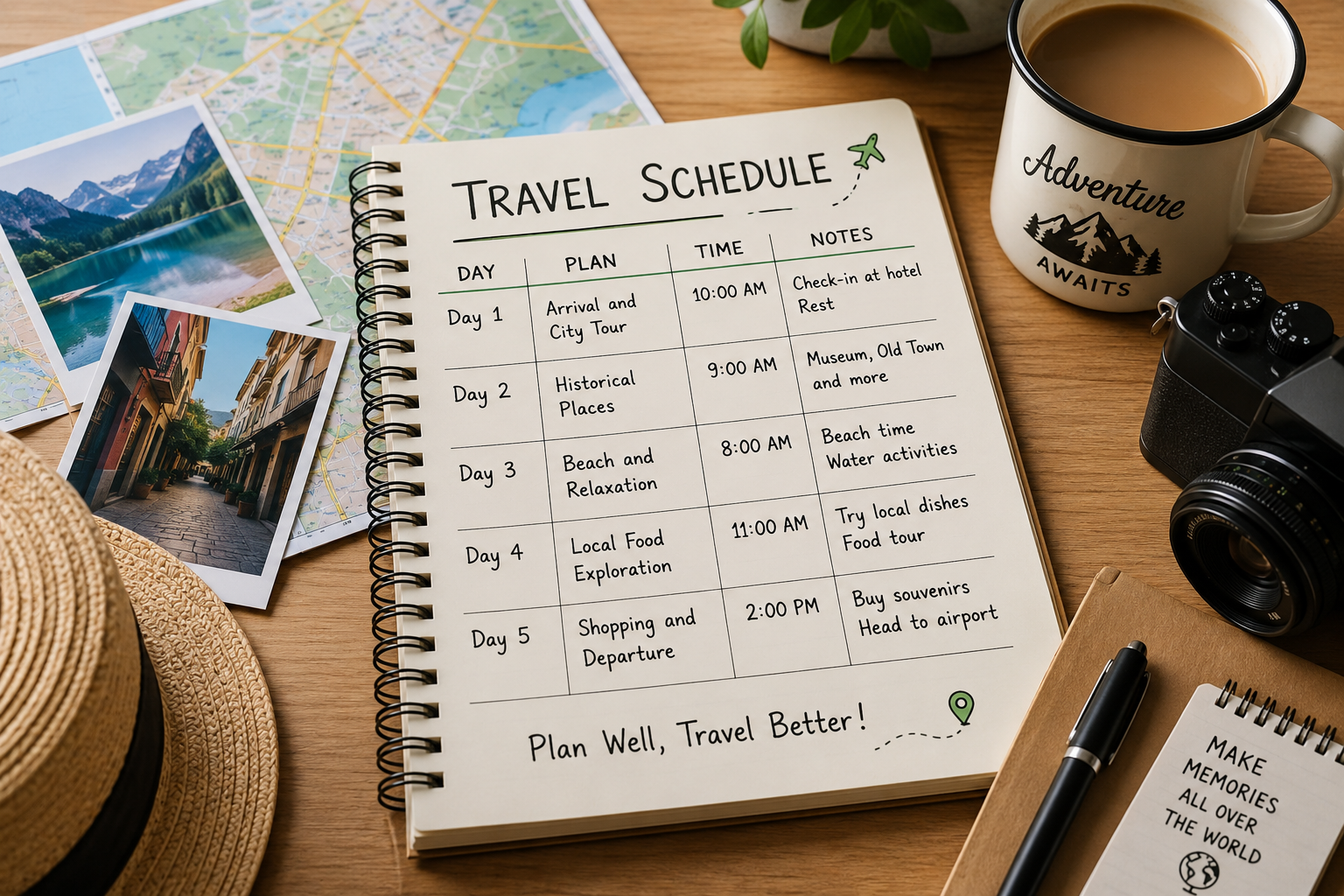
When I plan a trip, I believe a good travel schedule should make the journey easier, not make it feel like another responsibility. A simple and flexible schedule helps me know where I need to be, what I want to see, and how much time I have without making every minute of the trip feel controlled.
Many travelers make the mistake of filling every hour with activities. At first, this may look like good planning, but it can quickly become stressful. Travel should give us enough time to explore, relax, enjoy local food, take pictures, and experience the destination naturally. This is why I prefer creating a travel schedule that is simple, realistic, and easy to follow.
In this guide, I will explain how I create a travel schedule and share practical tips that can help make any trip more organized.
Start With Your Main Travel Goals
Before creating a travel schedule, I first think about what I actually want from the trip. Every destination offers many attractions, but I do not need to visit everything.
For example, if I am visiting a historic city, my main goal may be to explore museums, old buildings, and cultural areas. If I am visiting a beach destination, I may prefer relaxing, enjoying the coastline, and trying local food.
Knowing my main travel goals makes it easier to decide what belongs in my schedule and what I can skip. This also prevents me from wasting time on activities that are not important to me.
Decide How Many Days You Have
The next step is to understand exactly how many days are available. I always consider the arrival and departure times instead of treating every day as a full day.
For example, if I arrive at my destination at 6 PM, I would not plan a full sightseeing day. I may simply check into my accommodation, have dinner, and take a short walk.
Similarly, if my flight leaves at noon on the final day, I need to leave enough time for packing, transportation, and airport procedures.
A realistic travel schedule begins with the actual time available rather than the number of calendar dates.
Make a List of Places You Want to Visit
Once I know my available time, I make a simple list of places and activities that interest me. I do not immediately put them into a schedule.
I usually divide them into three groups. The first group contains places I really want to visit. The second includes activities I would enjoy if I have enough time. The third contains optional places that I can skip without feeling disappointed.
This method makes the travel schedule much easier to manage. If something takes longer than expected, I can simply remove an optional activity instead of changing the entire day.
Group Nearby Places Together
One of the most useful travel planning tips I have learned is to group nearby attractions together.
If three interesting places are located in the same neighborhood, I prefer visiting them on the same day. This saves transportation time and reduces unnecessary travel across the city.
For example, I might plan a museum, historical street, local market, and restaurant in one area for the same day. Another day can be reserved for attractions in a different part of the destination.
This approach makes a travel itinerary more efficient and gives me more time to actually enjoy the destination.
Avoid Planning Every Minute
A common mistake when creating a travel schedule is making it too detailed. Planning every minute may look organized, but real travel rarely goes exactly according to plan.
A restaurant may take longer than expected. Traffic may cause delays. A beautiful location may make me want to stay longer. Sometimes I simply need extra time to rest.
For this reason, I like leaving empty spaces between major activities. These gaps give me the freedom to slow down without feeling like I am falling behind.
A good travel itinerary should provide direction while still allowing flexibility.
Give Important Activities a Fixed Time
Although I like flexibility, some activities need specific times. Flights, trains, tours, reservations, and certain attractions may have fixed schedules.
I always put these important items into my travel schedule first.
For example, if I have a guided tour at 10 AM, I plan my morning around it. I also leave enough time to reach the location because arriving exactly at the starting time can be risky.
Fixed activities act as the basic structure of the day. Other activities can be placed around them.
Add Travel Time Between Locations
Travel time is one of the most commonly forgotten parts of trip planning. A map may show that two locations are close, but reaching them can still take time because of traffic, public transportation, walking, parking, or finding the correct entrance.
I therefore include transportation time in my schedule.
If an attraction takes 30 minutes to reach, I do not simply write the attraction at 2 PM. I also consider when I need to leave my accommodation or previous location.
This small habit can make a big difference in keeping a travel schedule realistic.
Plan Your Day Around Energy Levels
Not every activity requires the same amount of energy. I try to think about how I will probably feel during different parts of the day.
For example, I might schedule sightseeing in the morning when I feel fresh. After lunch, I may choose something more relaxed. In the evening, I can enjoy a local restaurant, market, or peaceful walk.
I also avoid putting several physically demanding activities together.
A schedule should consider not only time but also energy. This makes the trip more comfortable and enjoyable.
Keep Meal Times Flexible
Food is an important part of travel, but I do not like planning every meal too strictly. Instead, I usually choose a few restaurants or local food areas I would like to try and keep some flexibility.
If I am already exploring an area, I can look for food nearby rather than traveling across the city just for one restaurant.
I also keep some extra time for meals because eating is not simply a task to complete. Local food can be part of the travel experience.
Create a Simple Daily Format
I find that a simple daily format is much easier to follow than a complicated spreadsheet.
For each day, I can write:
Morning: Main activity
Afternoon: Second activity
Evening: Food, relaxation, or optional activity
Transportation: Important travel details
This format gives me a quick overview without overwhelming me with information.
I can also include addresses, reservation details, estimated travel times, and important notes below each activity.
Leave Room for Unexpected Experiences
Some of my favorite travel experiences can happen when I am not following a strict plan. I may discover a beautiful street, meet interesting people, find a local market, or notice a small restaurant that was not in my original research.
This is why I always leave some free time in my schedule.
A flexible travel schedule gives me permission to change my plans. If something unexpected looks interesting, I can enjoy it without worrying about missing five other activities.
Keep the First Day Easy
I strongly recommend keeping the first day simple, especially after a long journey.
Travel can be tiring because of flights, airports, transportation, waiting, and unfamiliar surroundings. Trying to visit several attractions immediately after arriving can make the trip exhausting.
I prefer using the first day for checking in, getting familiar with the area, eating something local, and taking a short walk if I have enough energy.
A relaxed beginning can help me enjoy the following days much more.
Do Not Forget the Final Day
The last day also needs careful planning. I always consider checkout time, luggage, transportation, and the journey to the airport or station.
If my departure is early, I avoid planning a major activity on the final morning.
Having extra time on departure day reduces stress and gives me a better chance of reaching the airport or station comfortably.
Use a Digital or Printed Schedule
There are many ways to keep a travel schedule. Some people prefer travel planning apps, while others like using notes, spreadsheets, or a simple notebook.
I personally believe the best method is the one that is easy to check during the trip.
I keep important information such as accommodation details, transportation information, reservations, addresses, and daily plans in one convenient place.
I also recommend keeping important information available offline in case mobile internet is unavailable.
Review Your Schedule Before the Trip
A few days before traveling, I like to review the entire schedule.
I check whether opening hours have changed, whether reservations are confirmed, whether transportation makes sense, and whether I have given myself enough free time.
This final review often helps me find problems before the journey begins.
I also make sure that the schedule is not too crowded. If one day looks much busier than another, I move some activities around.
Keep Your Travel Schedule Flexible
The most important lesson I have learned about travel planning is that a schedule is a guide, not a rulebook.
Things can change. Weather can affect outdoor activities. Transportation can be delayed. Attractions can become crowded. Sometimes I may simply decide that I want a quiet afternoon instead of following the original plan.
That is completely fine.
A flexible schedule gives me structure while allowing me to enjoy the actual experience of traveling.
Final Thoughts
Learning how to make a travel schedule that is easy to follow does not require complicated planning tools. The most important thing is to understand what you want from the trip, organize activities by location, consider transportation time, and leave enough space for rest and unexpected experiences.
In my opinion, the best travel schedule is not the one with the most activities. It is the one that helps me enjoy the destination without constantly checking the clock.
I start with my main travel goals, decide how many days I really have, choose my most important places, group nearby attractions, and build a simple daily plan. I then add transportation time and leave some flexible periods.
With these simple travel planning tips, it becomes much easier to create a travel itinerary that feels organized but still relaxed. A well planned trip should give you confidence about what comes next while leaving enough freedom to enjoy the moments you never planned for.