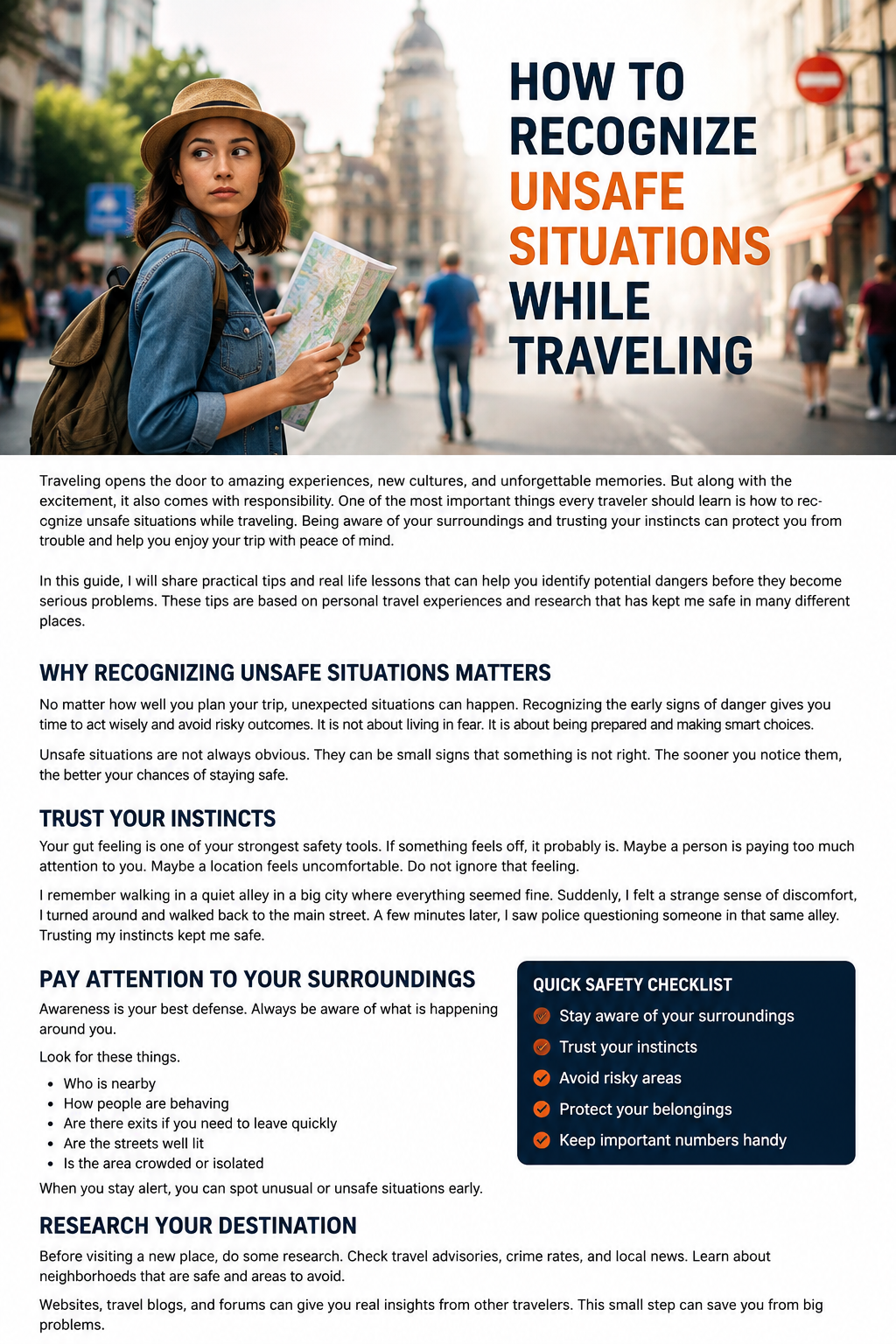
Traveling is one of the best ways to experience new places, meet different people, and create memories that stay with you for years. At the same time, every trip comes with some level of responsibility. When you are in an unfamiliar place, you may not always know which areas are safe, which situations should be avoided, or when someone’s behavior is unusual.
In my opinion, learning how to recognize unsafe situations while traveling is more useful than simply memorizing a long list of travel safety rules. You cannot predict everything that may happen, but you can learn to notice warning signs and make better decisions.
Being aware does not mean being afraid. It means knowing what is happening around you and trusting yourself when something does not feel right.
Why Recognizing Unsafe Situations Matters
Unsafe situations are not always obvious. Sometimes danger can begin with something small, such as someone following you, an unfamiliar person asking too many personal questions, or a location suddenly becoming empty and poorly lit.
The earlier you notice these signs, the more time you have to leave the situation. This is why situational awareness is such an important part of travel safety.
I believe that a safe traveler is not someone who expects the worst. A safe traveler is someone who stays prepared and knows when to change plans.
Trust Your Instincts
One of the most important travel safety tips I can share is to trust your instincts.
Sometimes you may feel uncomfortable without immediately knowing why. Maybe a person is standing too close to you. Maybe a street feels unusually quiet. Perhaps someone keeps looking at you or trying to start a conversation that feels strange.
Do not automatically ignore that feeling just because you cannot explain it.
Your instincts are often influenced by small details that you notice without consciously thinking about them. If something feels wrong, you do not need to prove that it is dangerous before leaving.
You can simply move to a safer place.
For example, if I were walking through an unfamiliar area and suddenly felt uncomfortable, I would rather turn around and find a busy public location than continue just because I wanted to follow my original route.
Pay Attention to Your Surroundings
One of the easiest ways to improve personal safety while traveling is to pay attention to what is happening around you.
Many travelers become distracted by their phones, cameras, maps, or conversations. When you are constantly looking at a screen, it becomes harder to notice unusual behavior.
When walking through an unfamiliar area, look around from time to time. Notice the people nearby, the condition of the streets, available exits, nearby businesses, and whether the area is becoming crowded or isolated.
Ask yourself simple questions.
Who is around me?
Does this area feel normal?
Are people behaving naturally?
Where could I go if I needed help?
Is there a safe place nearby?
These small observations can make a significant difference.
Be Careful When an Area Suddenly Becomes Empty
A crowded area is not automatically safe, but a sudden change from a busy environment to an isolated one deserves attention.
If you are walking somewhere and notice that shops are closing, streets are becoming empty, or there are very few people around, consider changing your route.
This is especially important after dark.
I personally think it is better to take a slightly longer route through a busy and well lit area than to save a few minutes by walking through an isolated street.
Watch for People Who Are Too Interested in You
Most people you meet while traveling will be friendly and helpful. However, excessive attention from a stranger can sometimes be a warning sign.
Be cautious if someone repeatedly asks where you are staying, whether you are traveling alone, how long you will be in the area, or where you are going next.
You do not have to share personal information with strangers.
A simple answer such as “I am meeting a friend nearby” can be enough. You can also politely end the conversation and move toward a public location.
There is no need to feel guilty about protecting your privacy.
Be Alert Around Transportation
Transportation is another area where travelers should stay aware.
Before entering a taxi or rideshare vehicle, check the vehicle information and make sure it matches the details provided by the service. If something does not look right, do not get inside.
At airports, train stations, and bus terminals, be cautious about strangers who aggressively offer transportation, accommodation, currency exchange, or tours.
Legitimate services usually do not need to pressure you into making an immediate decision.
I prefer arranging important transportation in advance whenever possible. It reduces confusion and makes it easier to recognize whether someone is offering a genuine service.
Be Careful With Unofficial Offers
Travelers are sometimes approached by people offering extremely cheap tours, tickets, transportation, accommodation, or other services.
A cheap offer is not always a scam, but pressure is a warning sign.
If someone says you must decide immediately or claims that a normal service is suddenly unavailable unless you pay them, take a step back.
Research prices before your trip so you have a general idea of what things should cost. This makes unusual offers much easier to recognize.

Notice Aggressive or Unpredictable Behavior
Another important sign of an unsafe situation is aggressive behavior.
Someone who is shouting, threatening others, behaving unpredictably, or appearing heavily intoxicated may create a situation that becomes dangerous quickly.
You do not need to confront such a person.
The safest choice is usually to create distance and move toward a public place with other people around. If necessary, contact local authorities or ask staff at a hotel, restaurant, station, or other established business for help.
Avoid trying to prove that you are brave. Leaving early is often the smarter decision.
Keep Your Valuables Secure
Unsafe situations can also involve theft.
Crowded tourist attractions, public transportation, markets, festivals, and busy shopping areas can provide opportunities for pickpockets.
Keep important belongings secure and avoid displaying large amounts of cash or expensive items unnecessarily.
I recommend keeping your phone, wallet, passport, and other essential items where you can easily control them.
It is also a good idea to keep digital copies of important travel documents in a secure location.
Avoid Being Too Distracted
Taking photographs and checking social media are normal parts of modern travel. However, constantly using your phone can reduce your awareness.
When walking through an unfamiliar place, especially at night, try to keep your attention on the environment.
If you need to check directions, stop somewhere safe rather than standing in the middle of an unfamiliar street while staring at your screen.
This simple habit can improve both travel safety and confidence.
Learn About Your Destination Before You Go
Preparation is one of the best ways to recognize unsafe situations.
Before traveling, research your destination. Learn about neighborhoods, transportation options, local customs, common scams, emergency services, and areas that visitors are advised to avoid.
Reading recent traveler experiences can also help you understand situations that may not be obvious from a standard travel guide.
I like to know the general layout of a destination before arriving. Knowing where my accommodation is located, which transportation options are reliable, and which areas are best avoided makes me feel more prepared.
Know When to Leave
One of the most important lessons I have learned about travel safety is that you should not wait until a situation becomes obviously dangerous.
If you feel uncomfortable, leave.
If someone is following you, enter a busy business or public place instead of going directly to your accommodation.
If a street feels unsafe, change your route.
If a stranger is pressuring you, end the conversation.
You do not need to wait for something bad to happen before taking action.
Stay Connected With Someone You Trust
When traveling alone, it is helpful to let someone you trust know your general plans.
You can share your accommodation details, transportation information, and basic itinerary with a family member or friend.
You do not necessarily need to provide constant updates. A simple check in system can provide peace of mind.
If your plans change significantly, let someone know when practical.
Learn Basic Local Safety Information
Knowing a few important local details can make a big difference.
Before arriving, learn the local emergency number and understand how to contact police, medical services, or your accommodation if necessary.
It can also be useful to learn a few basic phrases in the local language. Even simple words for help, police, hospital, or emergency can be valuable when communication becomes difficult.
Do Not Let Fear Control Your Trip
Travel safety is important, but I do not believe that travelers should spend their entire trip worrying about danger.
Most travel experiences are positive, and millions of people travel safely every year.
The goal is to develop awareness rather than fear.
When you understand how to recognize unsafe situations while traveling, you can enjoy your destination with greater confidence. You become more comfortable making decisions, changing plans, and walking away from situations that do not feel right.
Final Thoughts
Learning how to recognize unsafe situations while traveling is a skill that becomes stronger with experience.
Pay attention to your surroundings, trust your instincts, protect your personal information, research your destination, stay aware around transportation, and avoid unnecessary risks.
Most importantly, remember that you are allowed to change your plans. You are allowed to say no. You are allowed to leave a situation simply because it makes you uncomfortable.
For me, good travel safety is not about expecting something bad to happen. It is about being prepared enough to recognize warning signs before a small problem becomes a serious one.
With awareness, preparation, and common sense, you can explore new places while feeling more confident, comfortable, and in control of your journey.